PI COGNITIVE ASSESSMENT™
SO MISST MAN DIE LERNFÄHIGKEIT
“Combining the PI profile with the cognitive assessment, helps your recruiting and your hiring managers better understand what it is they’re getting with a candidate.”

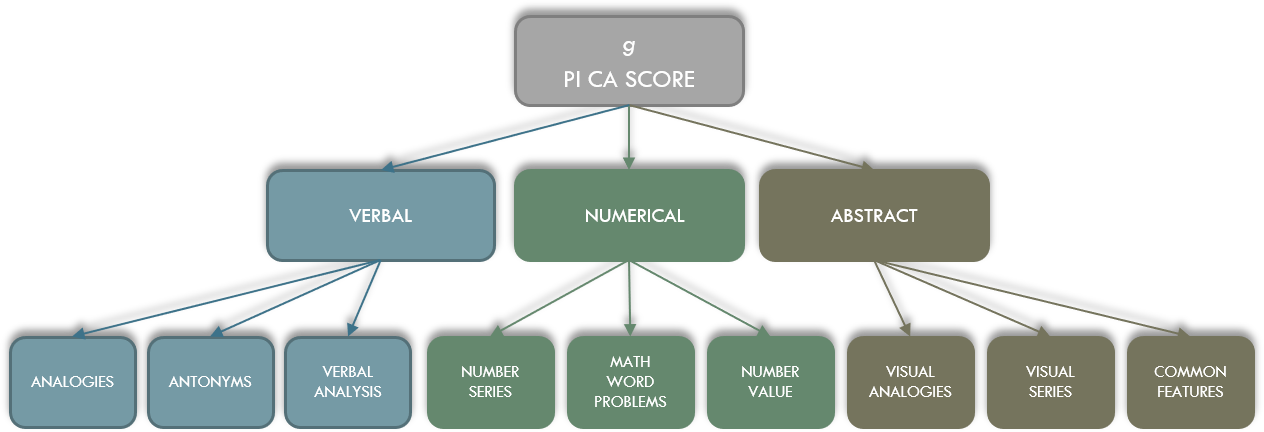
PI Cognitive Assessment™ misst die Lern- und Fortbildungsfähigkeit einer Person, d.h. wie schnell sie dazulernen, sich anpassen und neue Konzepte am Arbeitsplatz erfassen kann. Die Erfassung der kognitiven Fähigkeiten mit PI CA beruht auf der Analyse der allgemeinen Lernfähigkeit – dem g. Damit lassen sich Fortbildungserfolge und Leistungen auf allen Ebenen zuverlässig vorhersagen. Wer die Lernfähigkeit einer Person erkennt, trifft eine fundiertere Bewerberwahl für die Komplexität einer Rolle.
“PI is simple for candidates to complete and does not take long. It is easy to bring into the conversation with the manager when discussing candidates.”
“PI essentially gives you insight into other people. I can simply say that I have never regretted using PI, and I still use it.”
EINLEUCHTEND und WISSENSCHAFTLICH FUNDIERT
PI CA ist in über 65 Sprachen verfügbar und beruht auf einem linearen Ad-hoc-Design (LOFT) – jede Erhebung ist somit einzigartig. PI CA ist wissenschaftlich unterbaut und beruht auf den strengen Normen für die Testaufbau der American Psychological Association (APA), Society for Industrial and Organizational Psychology (SIOP) und International Test Commission (ITC)
PI Cognitive Assessment™ hieß früher „Professional Learning Indicator“ (PLI) und „Predictive Index Learning Indicator“ (PI LI).
ANWENDEN VON PI CA
Arbeiten Sie mit PI CA, um zu erkennen, wer bei Bedarf schnell und eigenständig dazulernt und wer die gestellten Anforderungen erfüllt oder gar übertrifft.PI Job Assessment™ hilft bei der Ermittlung der Komplexität einer Aufgabe. Mit PI CA erforschen Sie darüber hinaus, wie viel Komplexität eine Person bewältigen kann.
Im Zusammenspiel mit dem PI Behavioral Assessment™ verachtfachen Sie die Chancen, die Leistungsfähigkeit in einer bestimmten Funktion akkurat vorherzusagen. PI CA verdient somit einen Stammplatz in Ihrem „Werkzeugkasten“.
PI COGNITIVE ASSESSMENT™
In unserem Prospekt finden Sie weitere Hinweise zur Anwendung von PI CA
FAQ
FREQUENTLY ASKED QUESTIONS ABOUT THE PI COGNITIVE ASSESSMENT
What is the PI Cognitive Assessment?
The PI Cognitive Assessment is a scientifically developed assessment that measures an individual’s cognitive capacity and ability to learn quickly, adapt and solve problems. It is designed to predict how quickly someone can acquire new knowledge and handle complexity in the workplace.
What does the PI Cognitive Assessment measure?
The PI Cognitive Assessment measures general cognitive ability, often referred to as learning capacity. Specifically, it assesses verbal reasoning, numerical reasoning and abstract reasoning. These abilities help indicate how quickly a person can learn, process information and adapt to new situations.
Is the PI Cognitive Assessment an IQ test?
Not exactly. The PI Cognitive Assessment measures general cognitive ability, which is related to IQ, but it is designed specifically for workplace use. Unlike traditional IQ tests, it focuses on predicting workplace outcomes such as learning agility, adaptability and job performance.
How does the PI Cognitive Assessment work?
The assessment consists of 50 multiple-choice questions completed within 12 minutes. It measures a person’s ability to reason across verbal, numerical and abstract information. The score is based on the number of correct answers and is compared to a norm group.
How long does it take to complete the PI Cognitive Assessment?
The PI Cognitive Assessment is a timed asssessment where you are presented with 50 questions and a time limit of 12 minutes.
What is a good score on the PI Cognitive Assessment?
There is no universally „good“ score. The right score depends on the complexity and requirements of the role. The assessment is scored on a scale from 100 to 450, with 250 representing the average score in the norm group. The higher the score, the greater the cognitive capacity.
How can candidates prepare for the PI Cognitive Assessment?
No preparation is required. The PI Cognitive Assessment is designed to be an accurate measure of general cognitive ability without any form of preparation. Assessment takers can familiarise themselves with the assessment format by taking a practice test known as the PI Cognitive Assessment Sample Questions.
Can you fail the PI Cognitive Assessment?
No. There is no passing or failing score on the PI Cognitive Assessment. The results provide information about cognitive capacity relative to a norm group. In hiring, the relevant question is whether the individual’s ability aligns with the role’s cognitive requirements.
Can The PI Cognitive Assessment predict job performance?
Yes. Decades of research in industrial-organisational psychology have shown that cognitive ability is one of the strongest predictors of job performance. The PI Cognitive Assessment helps organisations understand a person’s capacity to learn quickly, adapt and solve problems, which are important contributors to workplace performance.
Is it possible to cheat on the PI Cognitive Assessment?
Like most assessments, no test can eliminate all forms of cheating. However, PI has implemented measures designed to protect test integrity, including monitoring for unusual behaviour and technical features that discourage the use of external tools. As of yet, there is no evidence that AI tools are impacting the results of the PI Cognitive Assessment.
PI COGNITIVE ASSESSMENT PROBIEREN
Verschaffen Sie sich mit den Cognitive Assessment-Beispielfragen ein Gefühl für die PI CA– eine vierminütige Testversion des PI Cognitive Assessment, die Ihnen die Möglichkeit gibt, sich mit dem Inhalt, der Struktur und dem Format vertraut zu machen, bevor Sie das eigentliche Assessment durchführen. Die Beispielfragen können in 65 Sprachen ausgefüllt werden, genau wie das PI Cognitive Assessment. Es ist keine Registrierung erforderlich, und die Ergebnisse der Beispielfragen werden nicht gespeichert oder an Dritte weitergegeben.