

PI UPDATE
WHY LEADING PEOPLE BASED ON THEIR GENERATON DOESN’T WORK
For years, leaders and HR professionals have been told that each generation needs something different. Baby Boomers value hierarchy and stability. Generation X wants independence. Millennials want purpose and flexibility. Generation Z needs constant feedback and expects everything to be digital. It makes for an appealingly simple approach to leadership: identify someone’s generation, understand what supposedly motivates that group, and adapt accordingly. The problem is that the evidence doesn’t support it.
THE PROBLEM WITH GENERATIONAL LEADERSHIP
Generational leadership is based on the idea that people born during the same period share particular attitudes, values and workplace preferences. But this risks turning broad assumptions into stereotypes. In his book, “Farvel til generationsledelse” (Goodbye to Generational Leadership), author and leadership advisor Christian Qvick highlights three fundamental criticisms: generational leadership can be discriminatory, much of the popular literature around generations lacks scientific grounding, and the claimed generational differences in the workplace largely fail to appear in research.
The research presented is particularly striking. One study using data from 500,000 people between 1981 and 2022 found no generational differences in how important people considered work, leisure, good working hours, opportunities to take initiative, holidays, responsibility or good colleagues. A meta-analysis covering 143 studies similarly found no or only negligible differences between generations when it came to work values, engagement, job satisfaction, commitment, intention to leave, work-life balance and perceived stress.
A BETTER LENS: AGE, PERSONALITY, AND SOCIETY
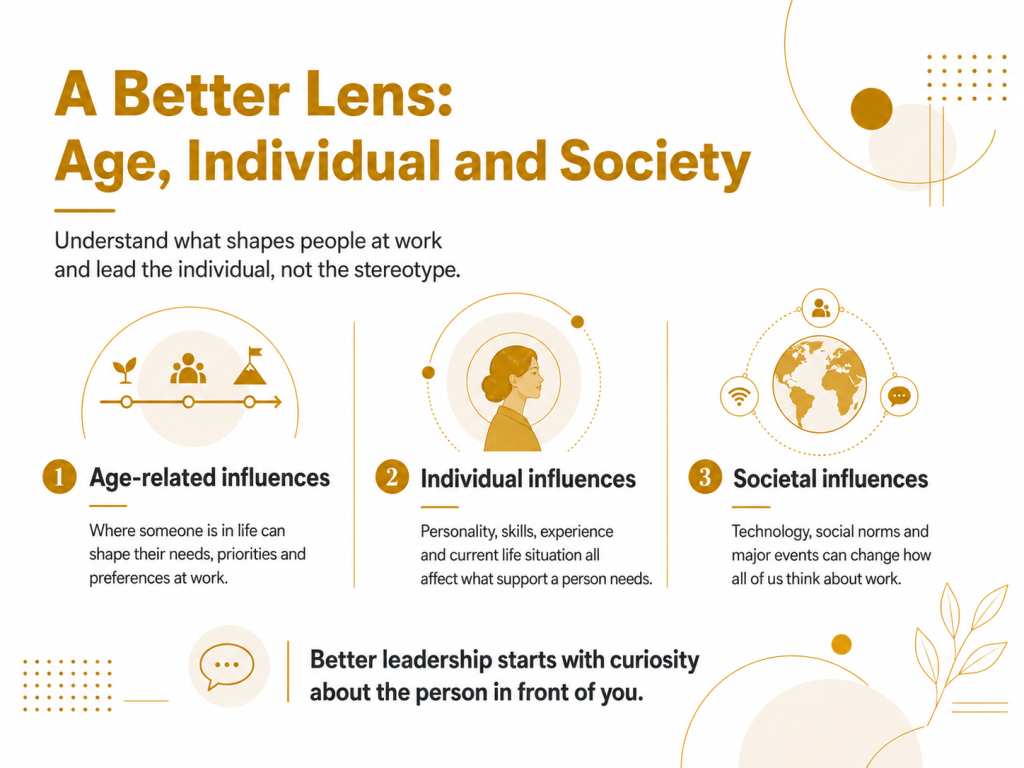
Rather than dividing employees into generations, Christian Qvick suggests looking at three influences on workplace preferences:
- Age-related influences concern where someone is in life. Different life stages may create different needs and priorities.
- Person-related influences include personality, skills, experience and an individual’s current life situation.
- Societal influences come from broader changes around us. Technology, social norms and major events can affect how all of us think about work, not only the youngest generation.
This creates a much more useful question for leaders. Instead of asking, „How should I lead someone from Gen Z?“, ask:
„What does this person need from me to perform, develop and thrive?“
That requires curiosity rather than assumptions. It means understanding people’s motivations and behavioural preferences, having regular conversations, considering their skills and circumstances, and adjusting leadership accordingly. Christian Qvick specifically points to personality profiles, competence profiles and frequent one-to-one conversations as practical ways of gaining that individual understanding.
MORE ALIKE THAN WE THINK
There is another important point easily lost in discussions about generations: people have a great deal in common. Meaningful work, flexibility, good colleagues, opportunities to develop and a healthy balance between work and life aren’t uniquely Millennial or Gen Z demands. They are human needs that may matter to people across age groups.
That doesn’t mean treating everyone identically. Quite the opposite. Good leadership recognises real individual differences without inventing differences based on demographic categories.
So perhaps the future of multi-generational leadership is simply better people management: understand the individual, consider their life situation and context, challenge your assumptions, and lead the person in front of you rather than the generation you think they represent.
NEWS FROM HUMANOSTICS
TARGETING WITH PI
In last month’s newsletter, we discussed the reasons for determining the behavioural and cognitive job requirements of a role before you start looking at your candidates‘ assessment results. Because otherwise, how do you know if they are a good match? If you are new to the process of job targeting, you may not know quite where to begin or how to do it well.
Our new guide to the PI Job Assessment and job targeting is a great place to start! Download the guide here, and do not hesitate to reach out to your PI Consultant if you would like some support along the way. We also recommend our free Focus Webinar ‚Profile the Job Like a Pro‘ which you can attend free of charge if you are certified in PI. Find dates for this and our other Focus webinars and sign up directly here.
INSPIRE YOUR PEOPLE
You already know that the PI assessments are excellent tools for hiring great talent. And you are aware that the PI Behavioral Assessment can also be used on your existing workforce. But where exactly, and how do you get started? And what if you do not have a lot of resources to implement big initiatives like development or leadership programmes?
Our new Focus Webinar ‚Inspire Your People with PI‘ gives you tips on how to use PI Inspire to help your employees understand themselves and each other better, and equip your managers to hone individual strengths, build meaningful relationships, and fast-track development. You’ll learn that even starting small can have a great impact. Find dates for this and our other Focus webinars and sign up directly here. Attendance is free of charge for anyone certified in PI.