

· · · · · ·
PI UPDATE
· · · · · ·
· · · · · ·
HOW HR CAN USE PI MORE STRATEGICALLY
A hiring manager is convinced they have found the right candidate. The person has relevant experience, communicates confidently and feels like a natural fit. Instead of simply confirming that impression, HR can use PI to bring another perspective into the discussion. Leaders will always rely partly on experience and instinct and in many situations, that instinct is valuable. The role of HR is not necessarily to challenge it, but to add context.
It could sound like this: “Your instinct may be right. Here is what the data suggests we should also consider.” Or: “If we choose this candidate, these may be the areas where additional support or management attention is needed.”
The conversation is no longer about whose opinion carries the most weight. Instead, HR and the leader can examine the information together and agree on the implications.
That is where HR begins to move beyond facilitating the hiring process and starts contributing to the quality of the decision. PI gives HR structured insights that can be used to examine assumptions, identify potential risks and ask questions that might otherwise be overlooked. It is not about replacing leadership judgement with data. It is about making that judgement more informed.
STARTING BEFORE THE RECRUITMENT PROCESS
The most important PI conversation may take place before any candidates are assessed. What does success in the role truly require? Does the hiring manager need someone who works in the same way as the previous employee, or has the role changed? Which behavioural demands are essential, and which are simply personal preferences? What is already present within the team, and what might be missing?
Creating a job profile together with the hiring manager and other relevant stakeholders makes these expectations visible. The question becomes less: “Do we like this person?” and more: “How well does this person match what the role and team require?”
LOOKING BEYOND THE ASSESSMENT
PI often enters an organisation through recruitment, but its value does not need to end when the candidate is hired. The same behavioural insights can support onboarding, management, team development, succession planning and organisational change.
A manager may use a new employee’s profile to consider how much direction they are likely to need during onboarding. A leadership team may use PI to understand why discussions repeatedly become dominated by certain perspectives. HR may use it during succession planning to explore not only who has performed well, but also what a future role will demand.
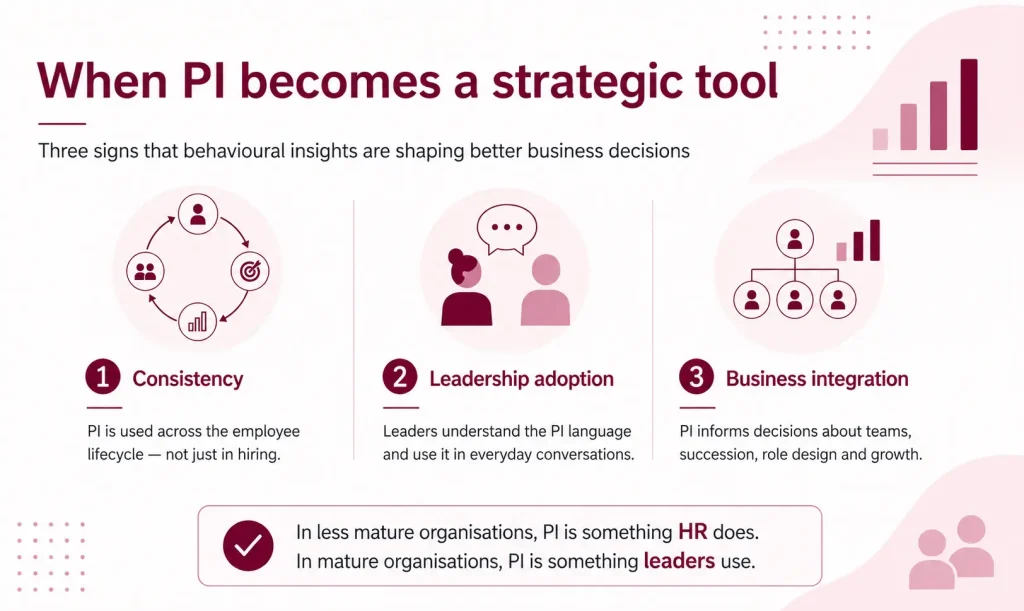
In organisations where PI becomes embedded, it gradually stops being something HR administers and becomes a language that leaders use.
Three elements tend to support this development: Consistency, leadership adoption, and business integration. The difference can often be heard in the language people use. Rather than asking HR to “run a profile”, leaders begin asking how behavioural dynamics might affect a role, team or business objective.
IMPROVING CONVERSATIONS ABOUT
TALENT AND POTENTIAL
Talent discussions can easily become influenced by visibility, personal chemistry and individual leadership preferences. One manager may value employees who speak quickly and confidently. Another may place greater emphasis on patience, precision or consistency. Both may believe they are assessing potential objectively, even though they are applying different criteria.
You can use PI to create a shared vocabulary for discussing those differences. Instead of describing someone as “not strategic enough” or “not leadership material”, HR can help clarify what the concern is actually based on. This distinction matters when organisations want to build more diverse teams.
People who communicate, decide or collaborate differently from the majority can easily be misunderstood. A quieter style may be interpreted as low ambition. A direct style may be seen as difficult. A preference for structure may be mistaken for resistance to change. PI helps teams examine these assumptions and distinguish between behavioural preference, capability and performance. The aim is not to eliminate differences or place people into fixed categories. It is to make those differences easier to understand and manage.
When HR brings these perspectives into the conversation, PI becomes more than an assessment. It becomes a framework for making more informed decisions about people, roles and teams.
NEWS FROM THE PREDICTIVE INDEX
THE PI BEHAVIORAL ASSESSMENT RE-CERTIFIED AGAINST EFPA STANDARDS
We’re proud to share that the PI Behavioral Assessment has been officially re-certified against the EFPA Test Review Model (v4.2.6) developed by the European Federation of Psychologists‘ Associations!
Every few years, an independent board of psychometric experts from DNV conducts a rigorous peer review of the assessment’s development, scoring, validity evidence, reliability, and fairness research.
The BA passed the full inspection and was awarded the Certificate of Conformity valid through 2031, reaffirming that it continues to meet the highest scientific and professional standards for workplace and selection use.
This certification is one of the strongest independent credibility signals an assessment can carry. The PI Cognitive Assessment has the same certifcation.
NEW FEATURE COMING: BEHAVIOURAL INTELLIGENCE AI
Introducing Obi , PI’s behavioral intelligence AI. Grounded in 70 years of behavioral science and your org’s actual data, not generic advice.
Obi is how HR’s coaching gets into every manager’s hands. Before every conversation that counts, use Obi to create tailored advice grounded in who’s actually part of the conversation. Not generic best practices.
Coaching powered by PI’s behavioral intelligence, ready before the review, the first 1:1, the feedback that can’t wait any longer. Managers walk in with the right words, and their people walk out with real direction.
Obi is available in the new version of PI Software which will be rolled out to Humanostics‘ clients over the next 6-12 months. Stay tuned for more information!