Paria Peyman

From Assessment to Influence: Define the Role!

Before you assess the candidate, define the role!

It sounds obvious – but in many recruitment processes, assessment comes after the hiring team has already formed an opinion.

The CV looks right. The conversation felt good. The experience seems relevant.

But the real question is not only: Do we like this candidate?

It is also: How well does this person match what the role actually requires?

That requires clarity before the process begins:

What does success look like, and which behaviours will the role demand?
What level of complexity will the person need to handle?
What is already present in the team—and what may be missing?

When the role is clearly defined, assessment data becomes much easier to use – not as a final answer, but as a way to structure the conversation and support better decisions.

This is part of the focus in our latest newsletter: how HR can move from simply using assessments to creating more strategic influence in conversations about people, roles, and teams.

Want more perspectives like this? Sign up for our newsletter with the link in the comments.

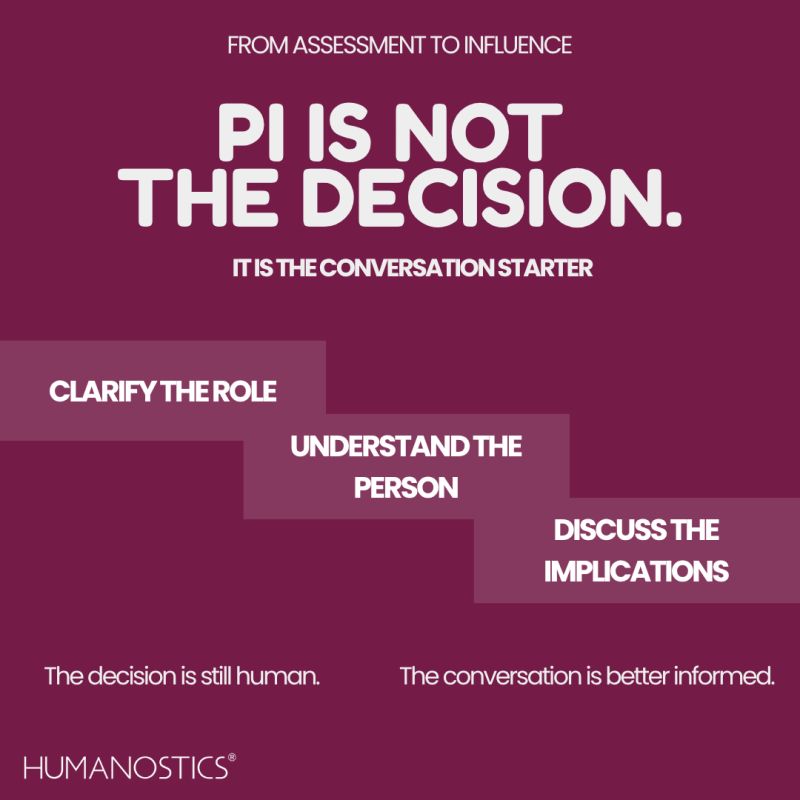
From Assessment to Influence: PI is not the decision…

It is the conversation starter.

Used well, assessment data does not replace judgement. It helps HR and leaders make that judgement more informed.

It creates a clearer foundation for discussing the role, the person and what may be needed for the match to succeed.

This is the final post in our August series: From Assessment to Influence.

The decision is still human.
The conversation is better informed.

Next week, we move on to a new theme.

View image

From Assessment to Influence: Your Instinct Might Be Right

Your instinct may be right… but it should not be the only thing in the room.

In people decisions, experience and intuition matter. They help leaders recognise patterns, read situations and make judgement calls.

But data can add another perspective.

It can help us ask better questions:

– What are we assuming?
– What might we be overlooking?
– What needs further exploration?

That is where PI becomes valuable. Not as the final answer, but as a way to qualify the conversation and make people decisions more informed.

This is also the focus of our latest Newsletter: how HR can move from simply using assessments to creating more strategic influence in conversations about people, roles and teams.

PI adds perspective. The conversation adds context.

Want more perspectives like this?

Sign up for our newsletter and get practical HR insights directly in your inbox.

graphical user interface, application

PI in Practice – Manufacturing

What does PI look like in practice in manufacturing?

In this manufacturing spotlight, The Predictive Index looks at how Teakdecking Systems, Inc uses behavioural insights to create greater clarity and confidence across the organisation.

A practical example of how understanding people can strengthen communication, collaboration, and performance.

Watch the video to see PI in action.

Poor Job Fit Is Like Writing with the Wrong Hand

Imagine being right-handed.

Now imagine being told to use your left hand at work. Every day.

You could probably do it. But it would take more energy.

You would be slower.

Less natural.

More frustrated over time.

That is often what a poor job fit feels like.

Not because the person lacks talent.

But because the role constantly asks them to work against their natural drives.

This is why defining the behavioural demands of a role matters BEFORE hiring.

When people are matched to roles where they can perform naturally, work becomes less about forcing fit – and more about enabling performance.

No alternative text description for this image

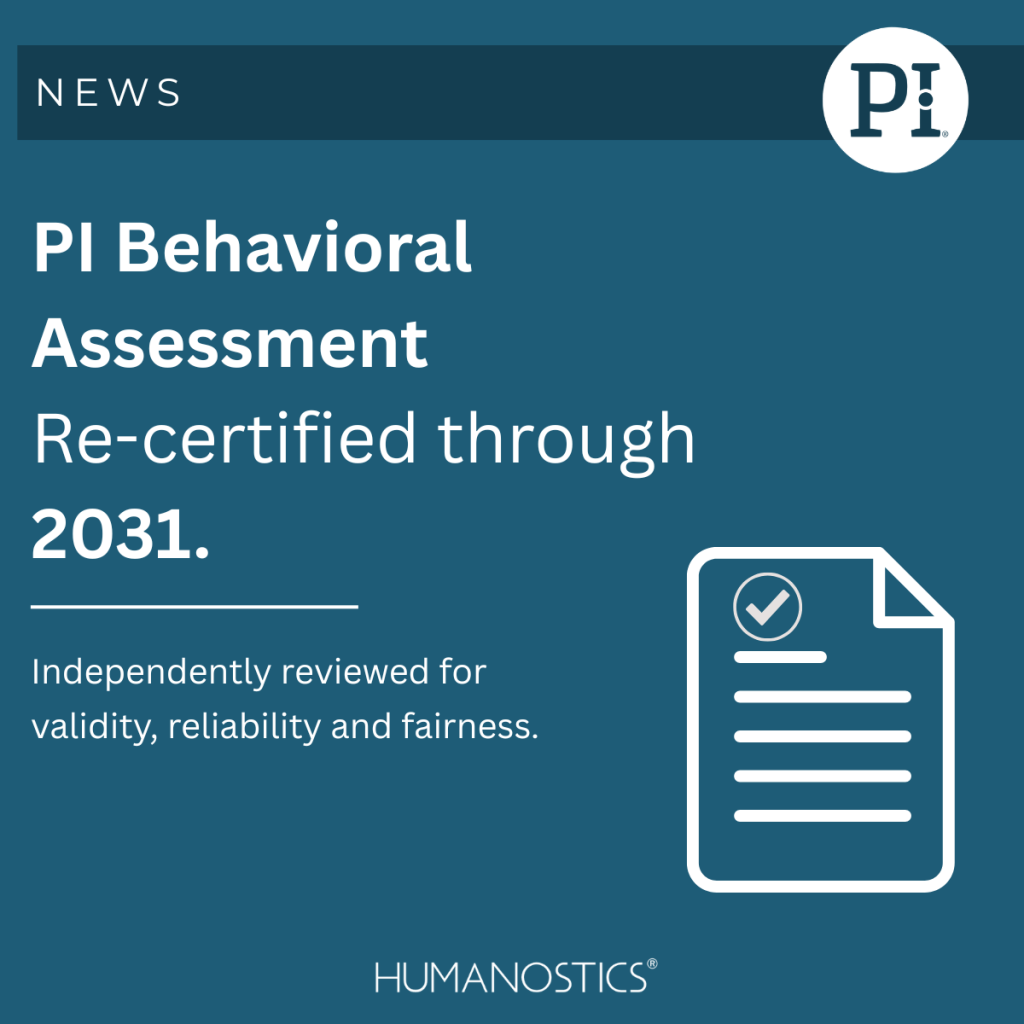
PI Behavioral Assessment Re-Certified Through 2031

Independent validation matters when assessments inform people decisions.

The Predictive Index Behavioral Assessment has officially been re-certified by the EFPA (European Federation of Psychologists’​ Associations AISBL) through 2031.

The assessment underwent an independent review of its development, scoring, validity, reliability and fairness – confirming that it continues to meet high scientific and professional standards for workplace and selection use.

For organisations using PI in recruitment and development, this provides continued confidence that the insights they rely on are supported by rigorous psychometric standards.

A strong recognition of the science behind PI.

The current image has no alternative text. The file name is: Webinars-8.png

The Path to a Great Onboarding Process

Success! Having spent time and money in the shape of ads, interviews, assessment feedback and various other things, you have finally found the ideal candidate for a job! Your new hire is the perfect match to the position and possesses the skills, experience, drives and learning ability to take on the role, and you can now move on with your other assignments. But wait! Your job as a leader is not over yet.

Your first priority is to ensure that the new hire gets a head start. There is not much time to demonstrate that you understand the new employee and that you have a genuine interest in them. According to the Aberdeen Group, companies with a structured onboarding programme have a better chance of retaining new employees – they are generally more engaged and they start delivering faster.

So – what to do?

First, you need to appreciate that perhaps not all managers have experience with onboarding. They need tips and sparring – preferably something that is easy and hands-on.

It is worthwhile to develop a checklist for the manager. Typically, HR has a list of things that need to be taken care of (e-mail address, comp. and ben., etc.) and likewise the manager needs a list which could include things like: Who should the new hire meet? What objectives should be reached first? Etc.

Moreover, the manager should be held accountable for the success of the onboarding (or lack thereof!). Successful onboarding should be one of his or her KPI’s.

How do you know what might be a good process for the individual? PI assessments can help you! When you know the assessment results, you get invaluable information about how much information they are likely to be able to process, how much instruction or support they need, and also how they prefer to learn. An extroverted person is likely to prefer to learn from others rather than having to read things on his or her own, while other might feel overwhelmed if they met too many people at the same time. If you understand the person and what drives him or her, there is a much better chance that they will feel engaged.

We all know that many apply for a job because they are attracted to the company, but they often leave because of the manager. So unless you ensure that the new hire feels energised during the onboarding process, there is a risk that you will soon have to fill the position again!

To learn more about creating a great onboarding process, feel free to contact us.

Welcome onboard

Sign up for the
Getting Started With PI
webinar!

By submitting this request, you consent to letting Humanostics ApS contact you on email with the requested information and for marketing purposes.