Is the PI Behavioral Assessment Valid?

We are often asked if the PI Behavioral Assessment is valid. This question may be understood in two different ways. Scientifically, validity refers to whether the tool measures what we say it measures. But usually the question refers to whether PI BA is ‘correct’, i.e. if people recognise themselves in the result.

Let’s have a look at the validity first: Many studies show that the behavioral assessment lives up to the standards and that it is not only valid – it measures what we say it measures – but also reliable, meaning that it measures stable factors. In fact, the PI BA was certified by DNV GL in 2018, and this means that the assessment meets the rigorous standards set by psychological experts in the European Psychological Association EFPA. In other words, PI BA is scientifically validated for occupational use in practically all types of jobs across all industries.

Moreover, PI’s own science team has conducted more than 350 validity studies documenting a relationship between factors / profiles and performance, based on an analysis of important parameters such as sales, customer satisfaction, and tenure.

But are assessment takers able to recognise themselves in the results? Judging from the responses we get, the answer is mainly yes. Perhaps the most comment we get is ”This is just spot on!”.

PI has also investigated this: Between May 2018 and August 2019 feedback was collected from assessment takers who received their behavioral report, the one which based on the assessment taker’s self pattern describes the most typical behaviour. 

In the email containing the report there was a link to a survey where the assessment takers could indicate to what extent they found the report precise.

Of the 3535 respondents who answered on their own behalf, 86 % gave a 4 or 5 out of 5 which indicates that the lions’ share of respondents found that the report was an accurate description of them.

The responses have also been matched with the reference profiles of the assessment takers. The most common reference profiles were Collaborator and Operator – both accounted for 9 % of the responses – whereas only 3 % were Analyzers. The reference profiles which were scored as the most precise were Captain and Persuader (with a score of 4.6 and 4.53, respectively) and the least precise was Individualist (3,86). Please note that were still many Individualists who found that the report correctly reflected them.

In sum: Based on scientific studies and on the feedback we get from assessment takers, we can conclude that the PI Behavioral Assessment is both very valid and very precise. The next step is to analyse if some of the words and phrases in the reports, for example the one describing Individualists, need to be adjusted, so we make sure that it is not a few words and phrases which elicit a negative response.

If you wish to know more, please contact us or click HERE.

PI Behavioral Assessment

Apples or Oranges?

Have you experienced a situation where stakeholders disagreed on candidates for a position? Or have you hired a person who quit the job prematurely? Perhaps the reason was that there was no alignment among stakeholders regarding the requirements of the job.

The PI Job Assessment (PI JA) is a pivotal part of the job analysis. The JA helps you clarify what behaviour and cognitive ability needed in order to be successful in the job, and this benchmark can complement what bother criteria you might have. Before you start interviewing candidates, you need to ask yourself:

  • What does the job really entail?
  • Which skills are needed?
  • What type of person would shine in such a job?
  • How does this behaviour match the goals and the strategy of the organisation?
  • How complex is the job?

The intention is to be as objective as possible in the recruitment process. Gut feeling might be a good thing, but if you rely too much on that you might become too subjective in your approach. We recommend that any recruitment process begins with a JA and furthermore that you get input from more than one person. Apart from the hiring manager there might be other stakeholders relevant to include, for example the person previously performing the role, someone from HR, a colleague who is going to work very closely with the new hire etc. It takes only about 10 minutes to fill in the questionnaire, and when results are in, you make a list of the things everyone agrees on, as well as a list of things stakeholders do not agree on. Based on this you facilitate a discussion in order to reach alignment among the stakeholders.

This step is very important. When there are differences in the input, it means that different stakeholders have different ideas about the job requirements. By involving the relevant people, you get as much information as possible about the job, and when you have reached agreement, you finalise the job target or benchmark and can generate a report describing the job. Your next step is to write a compelling job ad which attracts the candidates you wish to appeal to, so it might be a good idea to use some of the words and phrases in the job report. If you’re looking to hire a payroll assistant, you might want use words like ‘analytical’, ‘methodical’ and ‘very structured’, rather than the ‘outgoing, flexible team player described in many job ads. In other words: Get to know the job before you get to know the candidates. This is the recipe for a successful recruitment process!

To learn more about the PI Job Assessment, click HERE or feel free to contact us.

Predictive Index Job Assessment

The Path to a Great Onboarding Process

Success! Having spent time and money in the shape of ads, interviews, assessment feedback and various other things, you have finally found the ideal candidate for a job! Your new hire is the perfect match to the position and possesses the skills, experience, drives and learning ability to take on the role, and you can now move on with your other assignments. But wait! Your job as a leader is not over yet.

Your first priority is to ensure that the new hire gets a head start. There is not much time to demonstrate that you understand the new employee and that you have a genuine interest in them. According to the Aberdeen Group, companies with a structured onboarding programme have a better chance of retaining new employees – they are generally more engaged and they start delivering faster.

So – what to do?

First, you need to appreciate that perhaps not all managers have experience with onboarding. They need tips and sparring – preferably something that is easy and hands-on.

It is worthwhile to develop a checklist for the manager. Typically, HR has a list of things that need to be taken care of (e-mail address, comp. and ben., etc.) and likewise the manager needs a list which could include things like: Who should the new hire meet? What objectives should be reached first? Etc.

Moreover, the manager should be held accountable for the success of the onboarding (or lack thereof!). Successful onboarding should be one of his or her KPI’s.

How do you know what might be a good process for the individual? PI assessments can help you! When you know the assessment results, you get invaluable information about how much information they are likely to be able to process, how much instruction or support they need, and also how they prefer to learn. An extroverted person is likely to prefer to learn from others rather than having to read things on his or her own, while other might feel overwhelmed if they met too many people at the same time. If you understand the person and what drives him or her, there is a much better chance that they will feel engaged.

We all know that many apply for a job because they are attracted to the company, but they often leave because of the manager. So unless you ensure that the new hire feels energised during the onboarding process, there is a risk that you will soon have to fill the position again!

To learn more about creating a great onboarding process, feel free to contact us.

People Intelligence Starts with PI

At Humanostics, we believe the future of work is all about People-Powered Performance – and it starts with making smarter people decisions, supported by data.

Using data to guide decisions about people helps organisations move from assumptions to real understanding – and creates stronger teams, better leadership, and lasting performance.

We want you to think of PI as the foundation of people intelligence.

So instead of PI being just a tool or system, think of it as:

👉 the foundation for understanding the people in your organisation.
👉 the core source of insight behind better hiring, engagement, performance, and team design.
👉 the data-driven backbone that supports all people-related decisions.

In other words, we want you to think:

People Intelligence starts with PI – it is the groundwork everything else is built on.

Applying PI graphic

Introducing Behavioural Intelligence

EXCITING NEWS!

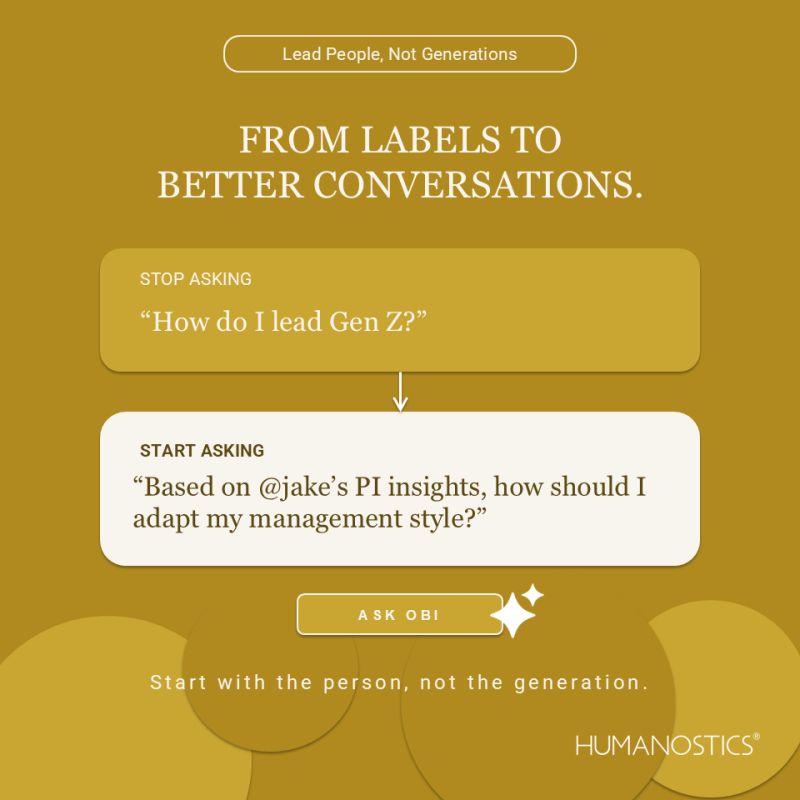
The Predictive Index has introduced Obi: AI-powered coaching designed to help managers prepare for the conversations that matter most.

From difficult feedback discussions to important 1:1s, Obi brings behavioural intelligence into everyday management moments.

We, at Humanostics, are excited about what’s ahead and look forward to bringing this capability to our clients in the future.

Stay tuned!

Introducing PI Obi

Sign up for the
Getting Started With PI
webinar!

By submitting this request, you consent to letting Humanostics ApS contact you on email with the requested information and for marketing purposes.