


· · · · · ·
PI UPDATE
· · · · · ·
· · · · · ·
WHY YOUR BEST EMPLOYEES DON’T ALWAYS BECOME YOUR BEST MANAGERS
When a leadership position becomes available, the choice often falls on the department’s strongest specialist. Why? Because it seems logical. The person delivers results, possesses deep expertise, and is respected by their colleagues. If they have been successful as an individual contributor, why wouldn’t they also be successful as a leader?
But the reality is often quite different. Many organisations find that some of their most valuable specialists struggle when stepping into their first leadership role. Not because they lack talent or ambition, but because the demands of the role change significantly. Delivering results yourself is not the same as delivering results through others.
FROM SPECIALIST TO MANAGER: ONE OF THE MOST CHALLENGING CAREER TRANSITIONS
Imagine an experienced specialist who has consistently been one of the organisation’s top performers. When complex challenges arise, she is the person colleagues turn to. She delivers high-quality work, takes ownership, and has a reputation for getting things done correctly and on time. When her manager leaves, she is promoted. Everyone agrees it is the right decision.
But after a few months, challenges begin to emerge. She continues to handle the most important tasks herself because she knows she can complete them faster. She struggles to delegate and spends more time focusing on details than on people. At the same time, her team feels they lack guidance, feedback, and direction. For the first time in her career, she begins to question whether she is succeeding.
WHEN THE DEFINITION OF SUCCESS CHANGES
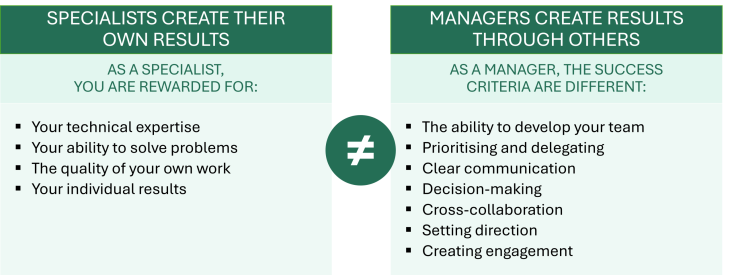
As a specialist, success is typically measured by expertise, problem-solving ability, and the quality of one’s own work. As a manager, success is increasingly measured by the ability to develop employees, communicate effectively, delegate responsibility, make decisions, and create engagement. Technical competence remains important, but it is rarely enough on its own. One of the biggest challenges for new leaders is accepting that their success now depends on the success of others.
HOW DO YOU IDENTIFY LEADERSHIP POTENTIAL?
Many organisations still base promotions primarily on past performance. The challenge is that past performance does not necessarily tell us how someone will perform as a leader. The best specialist is not always the best person to motivate others, manage conflict, or create direction for a team.
This is why more and more organisations are supplementing experience and results with insights into motivational drives and cognitive capacity. The goal is not to find one ideal leadership profile, but to build a stronger foundation for assessing how an individual is likely to perform in the role and what support they may need to succeed.
With PI, motivational and cognitive data are used alongside traditional performance measures to provide a more complete picture of a candidate’s strengths and potential development areas before they step into a leadership role.
SUPPORT THE TRANSITION, NOT JUST THE PROMOTION
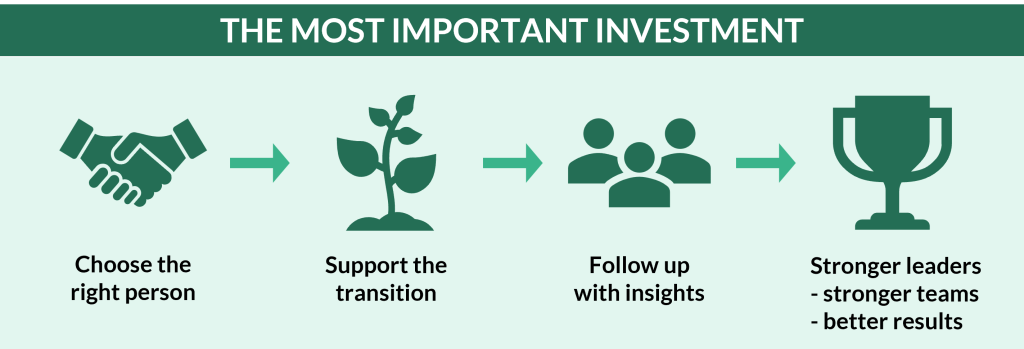
Even the right candidate can struggle if the organisation does not invest in the transition. Leadership onboarding, coaching, mentoring, and leadership development programmes can make a significant difference. The earlier organisations help new leaders develop the skills they need, the greater the likelihood of long-term success.
It is also important to understand how leaders are perceived by the people around them. This is where 360-degree feedback can provide valuable insights. Use tools such as the LPindex 360 to support leadership development conversations. The objective is not evaluation for the sake of evaluation, but to generate insights that can be translated into better leadership, development and stronger performance.
Promoting an employee into a leadership role is often a sign of trust. But trust alone is not enough. The organisations that succeed with internal talent development not only focus on who should become the next leader, but also on how they can help that person succeed once they get there.
Are you considering how to better identify, develop, or support new leaders in your organisation? Feel free to reach out for an informal conversation about the possibilities.